
There Be Monsters

We love monsters. We gag for them, froth for them. They’re meant to be scary and all the things we fear, but in truth, we love them, we can’t get enough of them.
Evidence? Halloween. Facts? All the hundreds of stores that pop up like Autumn mushrooms when October comes around. All the supermarkets that start stocking pumpkins, even though they’re not in season in Australia. All the $2 shops that fill to the brim with plastic crap that was made under terrible slave-like conditions in countries with smaller GDPs than ours. In October our front fences start to grow white fuzzy stuff that we think is cool and scary but is actually just terrible for birds and insects. On the night of Halloween we dress up as vampires, zombies, murderers, ghosts, witches and monsters. And then after we dress up as monsters, the young children eat so much sugar that entire dentists’ clinics are funded from this one night of revelry and madness.
We. Love. Monsters.
We love monsters the way we love horror and gore and true crime stories. We love them in the way we wallow in the horrific details of one misbegotten Beef Wellington meal. The way we all thought we could solve the mystery of the teacher’s pet and the disappeared wife. The way we think Dexter is really a good guy and just needs someone to understand him. He’s not a good guy! He’s a crazy serial killer!!
But why? What is it about Halloween, about monsters, about Evil with a capital E, that we humans so deeply love and are so desperately drawn towards?
I read Frankenstein by Mary Shelley recently. Yes I know, I’m late to the party (and if you haven’t read it yet, I strongly recommend it). I loved it, loved it in the way that I want to build a time-machine so I can go back in time and take Mary Shelley out for dinner and be that annoying fangirl that talks to her all night about that one strange dream she had. I loved that a 19 year old girl in 1816, about 80 years before Freud wrote his classic The Interpretation of Dreams, could dream up the perfect monster, who could absorb and embody all the terror and hatred we have for our own repressed desires.
In the story, Frankenstein’s monster, who is never named, comes into being through the egotism and arrogant mania of a brilliant young scientist. Horrified at what he has made, Frankenstein abruptly abandons his creation and so sets in motion the destruction of everything he loves most, including his own life. There are many interpretations and understandings of this accidental morality tale, but the one that feels very resonant in the days leading up to Halloween is that the story of Frankenstein tells us a profound message about what happens when we abandon the ugly, hateful parts of ourselves.
We all contain a version of Frankenstein’s monster inside us. The parts of ourselves that are consumed with violence, thirsty for revenge and crazed with a capacity to do harm. The parts of us that are bereft with loneliness, feel desperately misunderstood and pumped up with the driving force of our own victimhood. We believe the world owes us something, that we have been the most vilely wronged, that we have every right to cause endless harm and that we should never be held accountable.
Some of us allow this part of ourselves to come out in facebook comments or snarky, mean online posts. Some of us grow this part of ourselves to become our dominant identity. We believe for example, that even though we are strong and powerful, we can unendingly claim our victim status: I have been wronged and my revenge will not be denied. Some of us live out the call of the monster through the vicarious stories of others, becoming obsessed with true crime or zombie movies. Some of us feel the monster is so close and so threatening that we sell a car to pay for therapy…
More often than not, for most of us however, these angry, frightening beasts are the parts of ourselves that we reject. We push them down, deny their existence and repress the moans and cries that rise up from within our beleaguered psyches. We tell ourselves, believe ourselves, to be wholesome, good people, or at least moderately kind and not psychopathic. We cut off these parts of ourselves, these wild, untamed parts, and banish them from polite society where they are forced to live in the shadows. They are hidden from the conscious light of our egos and we might only notice them when our subconscious releases them in nightmares, or when we’re very drunk and uninhibited, or when that red sports car pulls out in front of you and a stream of invective flows from your mouth with words you didn’t even know you knew.
We love fairytale monsters, cherish them, exalt in them, because they enable us to avoid having to look inside ourselves, at the banality of evil that lies within us all. We can displace all the suppressed turmoil we feel inside about our own aching need to cause pain or to feel pain, onto our exaggeration of revulsion for BDSM, for example, or the way we love stories about women being kept in dungeons. We can silence our inner disquiet about our own thirst for blood by ‘appropriately’ becoming obsessed with vampires and werewolves. By elevating the ‘otherness’ of these monsters, we avoid having to interrogate or question the nagging voices in our own souls. What would it feel like to whip her? What would happen if I strangled him? What does human blood taste like?
Contemporary culture delights in pumping out and consuming monster narratives: True Blood, Interview with a Vampire, Harry Potter, Twilight, Wednesday, True Crime podcasts, on and on. And there are also specific times and places when acceptable society condones the appearance of monsters and invites us to dress up and bring them out to play: Halloween, fancy dress parties, festivals, carnivals and raves. At these designated times, even if we are unaware, we are participating in the ancient celebration of the ‘revels’. At these times, whether we know it or not, we join in the conga line of ‘dancing with the devil’ that goes far back in history. We enter into the practices of sacred dance or ritual play, creating safe, contained spaces for the beasts that live within us to come out and romp.
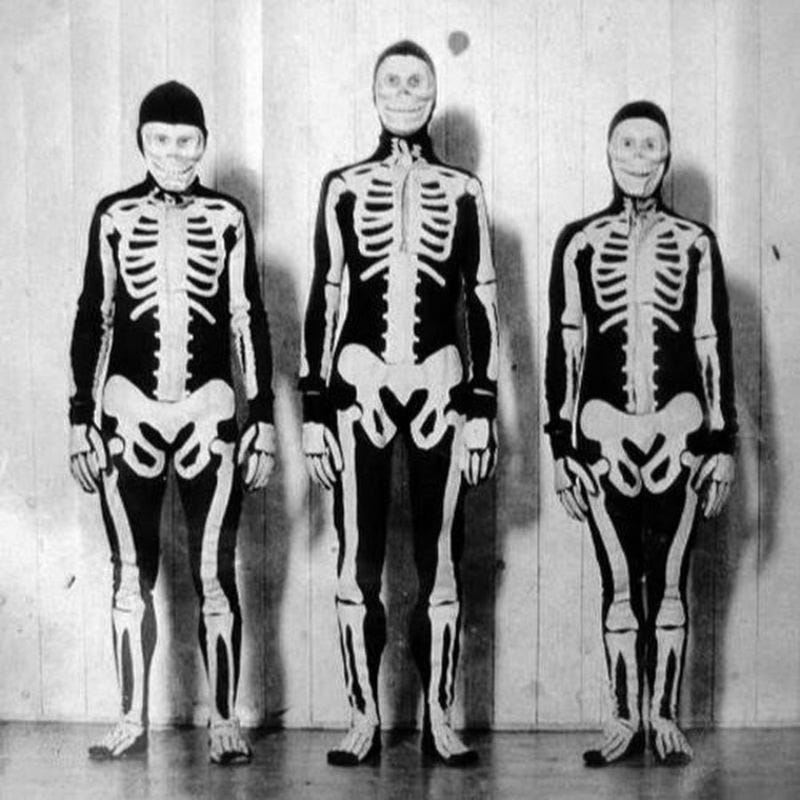
Masked performances were common throughout the ancient world, often celebrating seasonal cycles like the Solstices and the Equinoxes. In the Mesopotamian rituals of the Sacred Marriage, or heiros gamos, the King would symbolically unite with the masked fertility goddess to ensure a good harvest. In pagan Europe, a man would be paraded through the streets covered in leaves and foliage to represent the Green Man, the divine masculine symbol of fertility and renewal. In Northern Europe and across Russia, through China and Swana (South-West Asia and North Africa) we find rituals and traditions involving dressing up and masks.
By the Medieval times in Europe, these masked performers took on a particular name, the ‘Mummers’. The main feature of the performers was not only that they were always masked but that they were also silent, channelling archetypal characters and symbols. The masked performances would take place in public squares or common spaces, with the performers acting out stories often related to death and resurrection. The Mummers would also sometimes go from house to house with their masks and pranks, in a custom that may have fed into the contemporary ritual of trick or treat.
Halloween itself was historically a night to ward off evil spirits and reconcile with the dead. By wearing frightening costumes, people thought they could either scare away the evil spirits or trick them into believing they were one of them. Halloween became a day outside the norm, a topsy-turvy day, a day when people could step outside society’s constraints and act in otherwise unacceptable ways. In this way, it functioned as a release valve on the pressure of society’s expectations and enabled people to experiment, to play, to abandon and let go of all the rules and regulations of their normal lives.
Halloween is a moment to let the monsters inside come out to play. When we dress up we can be anonymous and terrifying, sexy and naughty; we can experiment with being something or someone that we are not. This holiday of chaos and fun, of screams and jokes, is a way to communicate safely with the monsters within.
And perhaps there’s also something deeper going on. It’s not just the monsters that we find unsettling, it is their connection to something in our past that we have forgotten, a connection to something other-than-human that has been severed.
We are frightened and also curious about what lies beyond the edge of reason, what is behind the veil. In an uncanny way, what we hide behind, the costumes we choose to disguise ourselves in, reveal more about what fascinates us, what calls to us, than we might realize. Our obsession with the macabre and the ridiculous on Halloween reveals our on-going fascination with what we cannot rationally understand. Maybe by dressing up as anything other than what we are, we can find a way, tease a sense, nudge at a path, that might weave us back to a past when we lived in connection with the land, with our ancestors and with the denizens of the unseen worlds.
What, Dear Reader, will you be wearing tomorrow night?
Thanks for your reflections on Halloween. I found myself really irritated by all things Halloween in Australia this year. It's the first one I've been here for in 10 years and in the last few years in Berlin I found Halloween and its close cousins Day of the Dead and Totensontag to be emotionally and spiritually nourishing occasions. Going into the 5 month winter, with days already ending at 4pm at the end of October is a daunting time. But having the opportunity to grieve those who have passed in the year and acknowledge our own darksides takes the edge off the dread and offers something with real potential for transformation.
Halloween in Australia felt to me like a demonstration of just how out of touch we are with Country, with the spirits of the land and with our own bodies. I'm looking forward to Samhain in May and hope that I can somehow just enjoy the absurdity of it all next year. This year I took the opportunity to get in touch with my inner-grump and appreciate the opportunity to write this comment as an expression of that shadowy character.